What is one important thing the brain does with new information during sleep?
Show the answer
Correct answer: It strengthens and organizes memories
During sleep, the brain continues processing information and strengthens useful memory connections.
AI for studying
A chatbot knows only what you paste into it. Connect PupilBot, and ChatGPT or Claude can read what you studied, which questions you missed, what is due for review and how your accuracy changes. Then it can help you decide what to study next.
Start free, then connect your AI See how it works
Photograph your notes or import a PDF. PupilBot writes the questions, grades your answers and schedules reviews with spaced repetition.
Add the PupilBot MCP server to ChatGPT, Claude, Claude Code or Codex, then sign in and approve. It takes about two minutes and needs no API key.
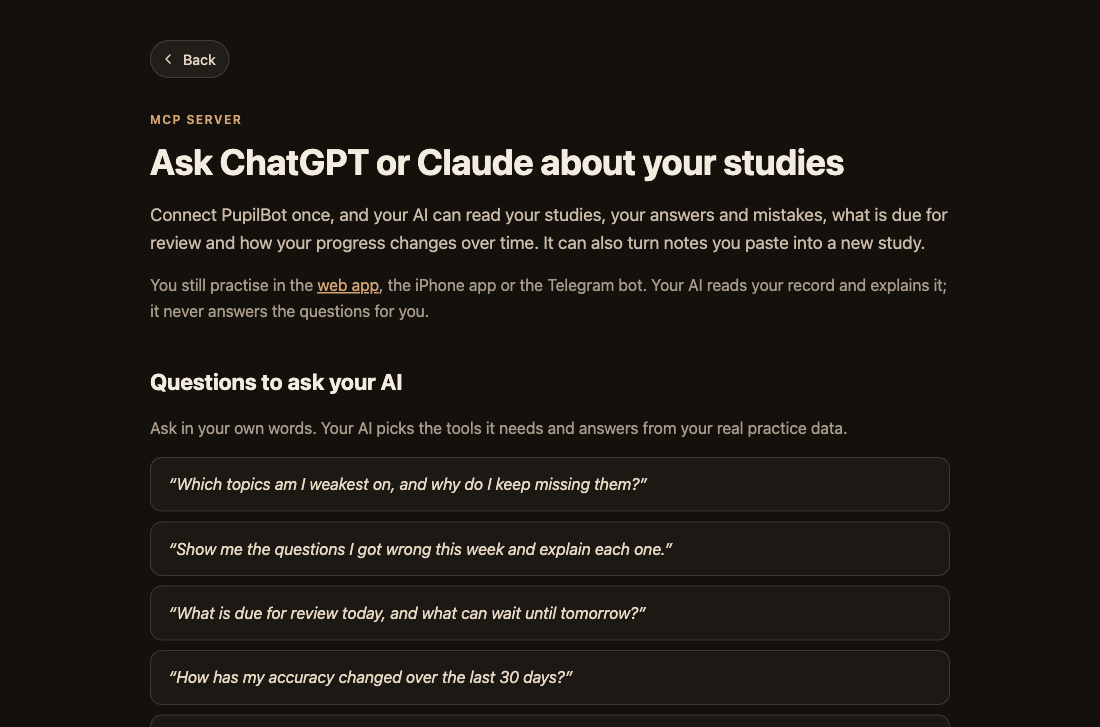
Ask which topics you keep missing, what is due today or how your week went. Your AI reads your real answers instead of guessing.
Answer a few of these questions, and your AI can read each one back: the question, your answer, the correct answer and the source line it came from.
This is the demo study every new PupilBot account starts with: a short text, and the flash cards and questions built from it — the same shapes the generator produces for your own pages.
Sleep is not just a period of rest. While you sleep, the brain continues to process information from the day. It strengthens useful connections, organizes new memories, and makes some information easier to recall later.
What is one important thing the brain does with new information during sleep?
Correct answer: It strengthens and organizes memories
During sleep, the brain continues processing information and strengthens useful memory connections.
Why can sleeping after learning help?
Correct answer: It can help stabilize and strengthen new memories
Sleep after learning can help the brain stabilize and strengthen newly formed memories.
Setup takes about two minutes: connect PupilBot to ChatGPT, Claude or Codex.
Your AI reads your record and can create a study from text. It cannot answer questions for you, change your scores or delete anything. You still practise in the web app, the iPhone app or on Telegram, so your record stays honest.
Add your notes to PupilBot and practise there. Then connect ChatGPT through the PupilBot MCP server. ChatGPT then answers from your real answers and mistakes, not only from what you paste into the chat.
Those modes change how the chatbot teaches inside one conversation. PupilBot keeps a record that lasts across sessions — every answer, mistake and review date — and your AI can read that record in any chat.
ChatGPT, Claude (web, desktop and mobile), Claude Code, Codex, and any other app that supports remote MCP servers with OAuth sign-in.
No. It sees only your own account: study titles, topics, questions, your answers and your progress. It never sees your photos, and you can disconnect it in Settings at any time.
You need an app that lets you add a custom MCP connector or server. OpenAI and Anthropic decide which of their plans allow that. Claude Code and Codex connect from the terminal.
PupilBot is free to start. A paid subscription unlocks more usage; the web app, the iPhone app and the Telegram bot all use the same account. Your first study is free, up to 3 pages. Premium: up to 50 pages per study. 5 study uploads per day · 50 per month.